Play as brain-building
The Gift of Boredom: What Grows in the Empty Afternoon
By Raised Editorial · ·
"I'm booooored" can sound like an alarm to fix. But the science of boredom suggests the empty afternoon is where creativity, problem-solving, and self-direction quietly grow. Here's how to hold the pause.
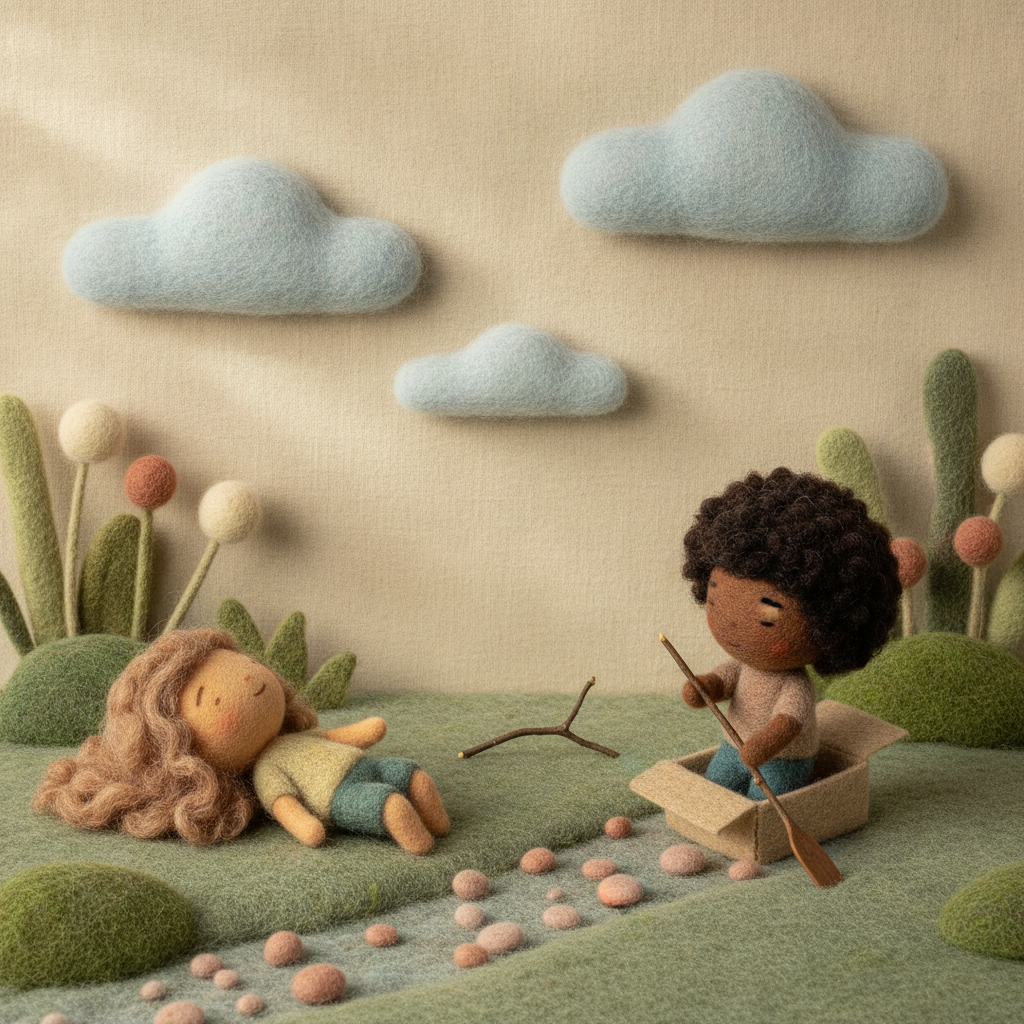
It usually arrives as a sigh, then a slump against the doorframe, then four drawn-out syllables: "I'm so booooored." Something in us tightens. We reach for a fix: a snack, a screen, a craft kit, a suggestion, anything to close the gap. Boredom can feel like a small emergency, a sign we've failed to provide enough.
But what if the gap isn't a problem to solve? A growing body of research suggests that the empty, unstructured afternoon is not wasted time at all. It's some of the most fertile ground your child's mind will ever stand on.
The Word That Makes Us Flinch
We live in a culture that treats unscheduled time as a vacuum to be filled. Calendars bloom with lessons, clubs, and playdates; pockets of dead time get topped up with a tablet. The intention is loving: we want our children stimulated, enriched, never falling behind.
Yet boredom isn't emptiness. It's a particular, slightly uncomfortable feeling that signals an unmet need for engagement, and crucially, it hands the job of meeting that need back to your child. When no one rushes in to fill the space, a child has to ask the most creative question there is: What now? Answering it, over and over, is how they learn to author their own time.
What Boredom Is Actually For
The discomfort is the point. When researchers Sandi Mann and Rebekah Cadman gave people a deliberately dull task and then a creative one, the bored participants produced more original ideas than those who weren't bored first (Mann & Cadman, 2014). Tedium, it turns out, nudges the mind to wander, daydream, and reach for novelty. Boredom is the itch; imagination is the scratch.
There's a deeper developmental story, too. In a study of six- and seven-year-olds, children who spent more of their week in less-structured activities, free play, reading for pleasure, open-ended pottering, showed stronger "self-directed executive functioning": the ability to set their own goals and work toward them without an adult steering (Barker et al., 2014). Children with more highly structured schedules showed the opposite. The logic is intuitive once you see it: if a grown-up is always deciding what happens next, a child rarely gets to practice deciding for themselves.
This dovetails with what pediatricians have been saying about play. The American Academy of Pediatrics describes unstructured, child-led play as essential for building executive function, language, and emotional regulation, not a reward to be earned after the "real" learning, but the engine of it (Yogman et al., 2018). Boredom is often just the doorway play walks through.
The Cost of the Constant Fill
Here is the gentle catch. Every time we instantly resolve boredom, we send a quiet message: an empty moment is an emergency, and someone else will rescue you from it. Screens are especially good at this rescue. They are engineered to eliminate the very pause where a daydream might have started, replacing the slow itch of "what now?" with an endless, effortless answer.
The result isn't a child who is more content; it's often a child who is less able to tolerate stillness, who reaches for the next hit of stimulation a little faster each time. The capacity to be alone with one's own thoughts, to sit in a slightly dull moment without panicking, is a muscle. It grows by being used.
You Don't Have to Be the Entertainment
If you've ever felt a flicker of guilt at not having a wholesome activity ready, let this be the reassuring part: you were never meant to be your child's cruise director. A parent who can warmly tolerate a child's boredom, who doesn't treat it as a five-alarm fire, is giving a gift, not withholding one.
This doesn't mean abandoning your child to misery. It means trusting the dip. Boredom often follows a predictable arc: a complaint, a stretch of restless fidgeting, and then, if no one intervenes, a spark. The doll gets a voice. The cushions become a fort. The stick becomes a sword, a wand, a fishing rod. The magic almost always lives on the far side of the whining, and the only way there is through.
What You Can Do Today
- Resist the instant rescue. When you hear "I'm bored," try a warm, unbothered, "That's okay. Boredom is your brain getting ready to make something." Then let the silence do its work.
- Build a 'yes space,' not a schedule. A low shelf of open-ended bits, blocks, paper, tape, fabric, jars of odds and ends, invites invention far more than a boxed activity with one right answer.
- Protect a daily pocket of nothing. Defend some unscheduled, screen-free time the way you'd defend a nap. Even twenty minutes of genuine emptiness is enough for a spark to catch.
- Hand the problem back. "Hmm, what could you do?" keeps the creative work where it belongs: with them. You're a lighthouse, not the boat.
- Let them see you be bored, too. Stare out a window. Doodle aimlessly. Model that a quiet, unproductive moment is a normal, even pleasant, part of being human.
A Final Thought
The next time those four long syllables drift down the hallway, you might feel that old urge to leap up and fix it. You can let it pass. Behind the complaint is a child standing at the edge of their own imagination, working out how to jump. Your job isn't to build the bridge. It's to stand nearby, unworried, and trust that the empty afternoon is doing exactly what it's supposed to do.
References
- Barker et al. (2014), Frontiers in Psychology — Less-structured time in children's daily lives predicts self-directed executive functioning
- Mann & Cadman (2014), Creativity Research Journal — Does Being Bored Make Us More Creative?
- Yogman et al. (2018), Pediatrics (AAP) — The Power of Play: A Pediatric Role in Enhancing Development in Young Children