Postpartum & Recovery
Why You Cannot Sleep Even When the Baby Sleeps
By Raised Editorial ·
The most common piece of advice is 'sleep when the baby sleeps.' But what happens when you are bone-tired, the baby is asleep, and your brain refuses to shut off?
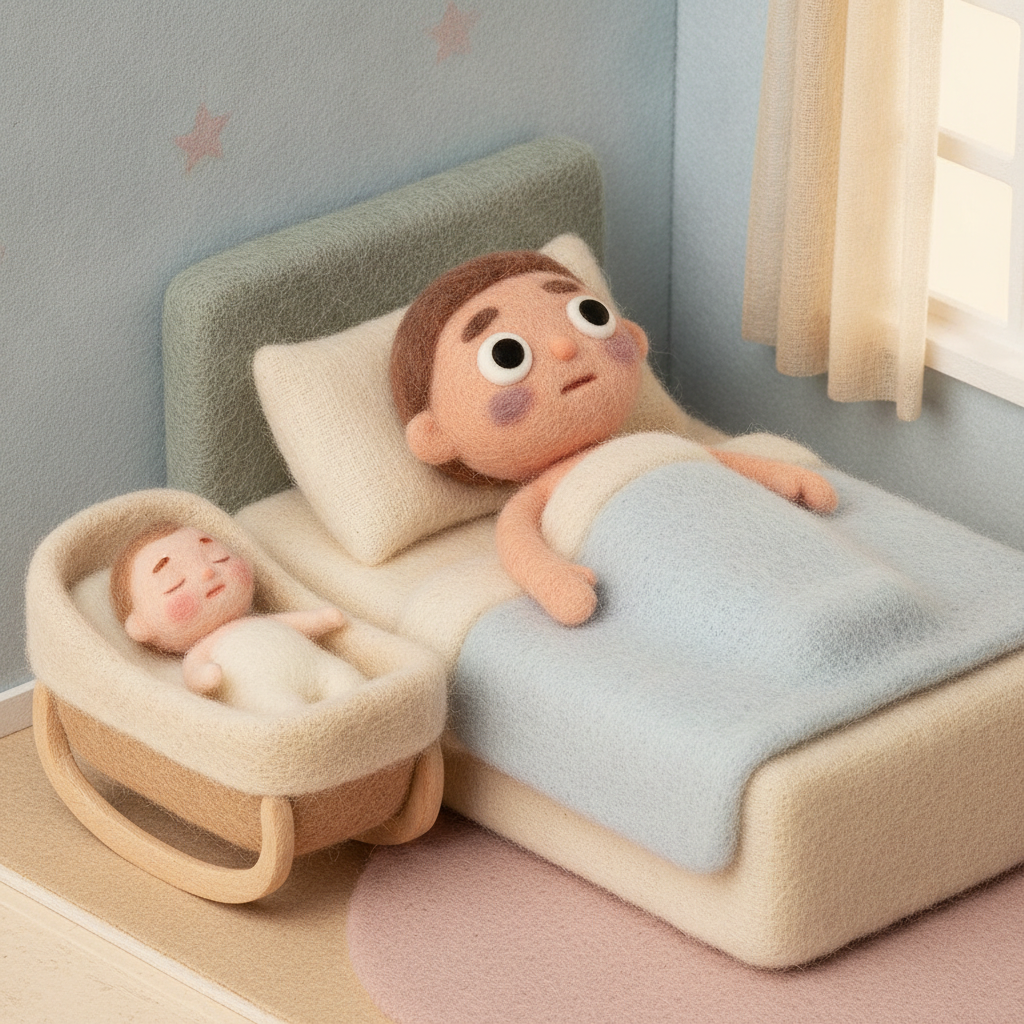
Before you had a baby, everyone told you: "Sleep when the baby sleeps!"
It sounds like incredibly logical, practical advice. But then the baby arrives, and reality hits. It is 2 AM. The baby is finally asleep in their bassinet. You lie down, close your eyes, and... nothing happens. You are so exhausted your bones ache, but your brain is buzzing like a neon sign.
This phenomenon is commonly known as postpartum insomnia. It is incredibly frustrating, but from a biological standpoint, your brain is actually doing exactly what it was designed to do. Here is why you cannot sleep, and how to tell your brain it is safe to power down.
The Biology of Postpartum Insomnia
When you become a parent, your brain undergoes structural changes designed to make you highly responsive to your infant's needs.
1. The "Threat Detection" Overdrive
Evolutionarily, human babies are born helpless. To keep them alive, your brain's threat detection system (the amygdala) becomes hyper-sensitive. Even when the baby is sleeping safely, your brain is scanning the environment for danger. This keeps you in a state of hyper-arousal—a low-level "fight or flight" mode.
You cannot sleep because your brain believes that if you let your guard down, the baby will be in danger. It is literally prioritizing the baby's survival over your sleep.
2. Hormonal Whiplash
After you deliver the placenta, your levels of estrogen and progesterone crash. Progesterone is a naturally sedating hormone; it helps you sleep deeply during pregnancy. When it drops, you lose that natural sedative. Simultaneously, the physical stress of sleep deprivation causes your body to produce excess cortisol and adrenaline to keep you awake.
Is It Normal, or Is It Postpartum Anxiety?
It is normal to have trouble falling asleep occasionally. However, chronic postpartum insomnia is often a primary symptom of Postpartum Anxiety (PPA) or Postpartum Depression (PPD).
Normal Adjustment: You struggle to fall asleep for 30 minutes, but eventually drift off, and you can generally sleep during the day if someone else is watching the baby.
A Sign to Get Help: You are awake for hours, staring at the ceiling. Your heart is racing, you are having intrusive thoughts (e.g., imagining the baby stopping breathing), and even when your partner takes the baby to another room so you can rest, you still cannot sleep.
How to Signal to Your Brain That It Is Safe to Sleep
You cannot logic your way out of biological hyper-arousal. You have to use physical cues to tell your nervous system that the "threat" has passed.
- Shift the Responsibility: If your partner is "on duty," you have to fully hand over the mental load. Put in earplugs or use a white noise machine so you cannot hear every grunt the baby makes.
- The 20-Minute Rule: If you haven't fallen asleep in 20 minutes, get out of bed. Lying there feeling anxious about not sleeping creates an association between your bed and anxiety. Go to a dimly lit room, read a boring book, and return to bed only when you feel sleepy.
- Box Breathing: This physical technique lowers your heart rate and signals safety to the brain. Inhale for 4 seconds, hold for 4 seconds, exhale for 4 seconds, hold for 4 seconds. Repeat.
If these strategies do not work, do not suffer in silence. Talk to your healthcare provider. Treating the underlying anxiety with therapy or safe medication is often the key to finally getting the rest you desperately need.