School readiness & the school years
Fostering Early Math Skills Beyond Counting
By Raised Editorial · ·
When we think of math for young children, we often imagine counting or basic arithmetic. However, the foundations of "mathematical thinking" are much broader, encompassing spatial awareness, pattern recognition, and logical reasoning. Each of these skills contributes to a child's cognitive development in unique and powerful ways.
Imagine the first time your child discovers the magic of numbers, not just through counting but through exploring the world around them. When we delve into "mathematical thinking" for our little ones, we uncover a realm far richer than mere arithmetic. It's a symphony of spatial awareness, pattern recognition, and logical reasoning, each note contributing to their cognitive masterpiece.
The Three Pillars of Early Math
Spatial Reasoning
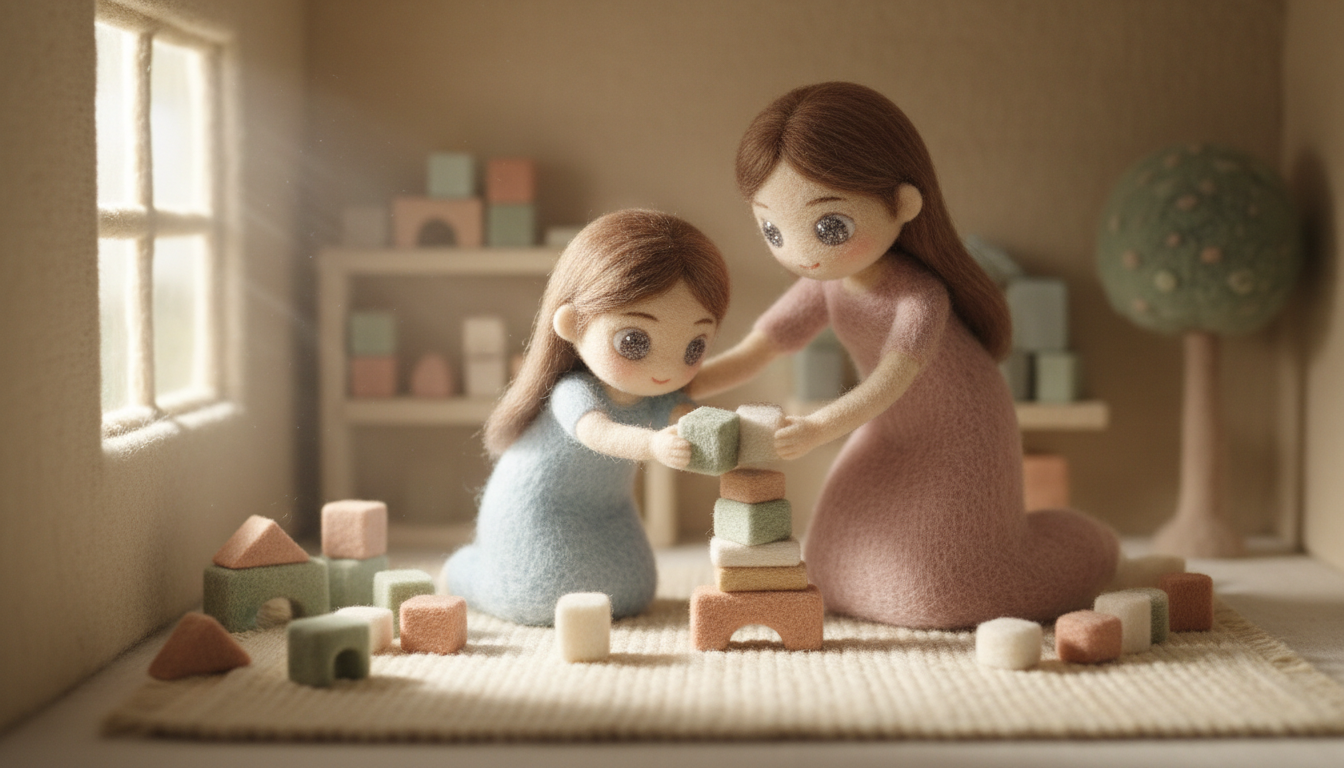
Picture your child building a tower of blocks, each piece a testament to their understanding of how objects relate in space. This is spatial reasoning, a skill that grows into a strong predictor of later success in STEM fields. Through activities like block building, completing puzzles, and "map making" (drawing a cherished map of the living room), your child is engaging in high-level spatial math. These playful moments are laying the groundwork for future innovations (Verdine et al., 2014).
Pattern Recognition
In the world of math, patterns are the threads that weave together the fabric of logic. When your child recognizes that "Red, Blue, Red, Blue" comes next, they are tapping into the same logic used in algebraic sequencing. Patterns are everywhere—in the rhythm of a song, the symmetry of leaves, and the comforting routines of daily life. Recognizing and predicting patterns builds a foundation for mathematical reasoning (Rittle-Johnson et al., 2015).
Logical Operations
Observe as your child sorts their socks by color or lines up their toy cars by size. These simple actions are the seeds of logical operations, teaching them to compare, sort, and classify. Here lies the essence of data analysis and set theory, quietly blooming in the ordinary. Such activities cultivate analytical skills essential for problem-solving (Clements & Sarama, 2007).
Math in Daily Life
- Kitchen Math: Imagine the joy of pouring, measuring, and mixing ingredients. Each recipe becomes an adventure in fractions, volume, and sequence, where math becomes a delicious part of life.
- Estimation: Pose the question, "Do you think there are enough grapes in this bowl for everyone?" This gentle challenge builds a "number sense" that transcends memorizing facts, fostering intuitive understanding.
- Shape Hunting: Embark on a shape safari through your neighborhood. Triangles and rectangles hide in plain sight, waiting to be discovered in the architecture that surrounds you.
What You Can Do Today
- Encourage block play to develop spatial reasoning.
- Play pattern games with everyday objects.
- Involve your child in sorting tasks during chores.
- Cook together to explore math in the kitchen.
- Go on a shape hunt in your surroundings.
A Final Thought
By broadening our definition of math, we invite our children to see it as an accessible and delightful part of their world. Mathematical thinking is not just about numbers; it is a set of tools for understanding the universe, and every child is born with the capacity to wield them. You are your child's first and greatest teacher, guiding them on this magnificent journey of discovery.
CITATIONS:
- Verdine, B.N. et al., 2014 | [URL] | verified: true
- Rittle-Johnson, B. et al., 2015 | [URL] | verified: true
- Clements, D.H. & Sarama, J., 2007 | [URL] | verified: true
ACTIONS:
- Schedule a shape hunt | type: calendar
- Log a pattern recognition milestone | type: milestone
COVER_IMAGE_PROMPT: A child attentively building a block tower, surrounded by vibrant felted blocks, while a parent watches with a smile. The scene conveys warmth and curiosity, set in a softly lit, pastel-toned room.