Feeding
Baby-Led Weaning (BLW) vs. Purees: Which is Better?
By Raised Editorial ·
The internet is fiercely divided between feeding babies purees and Baby-Led Weaning (BLW). Let's look at the clinical evidence to see which method is actually safer and better for your child's development.
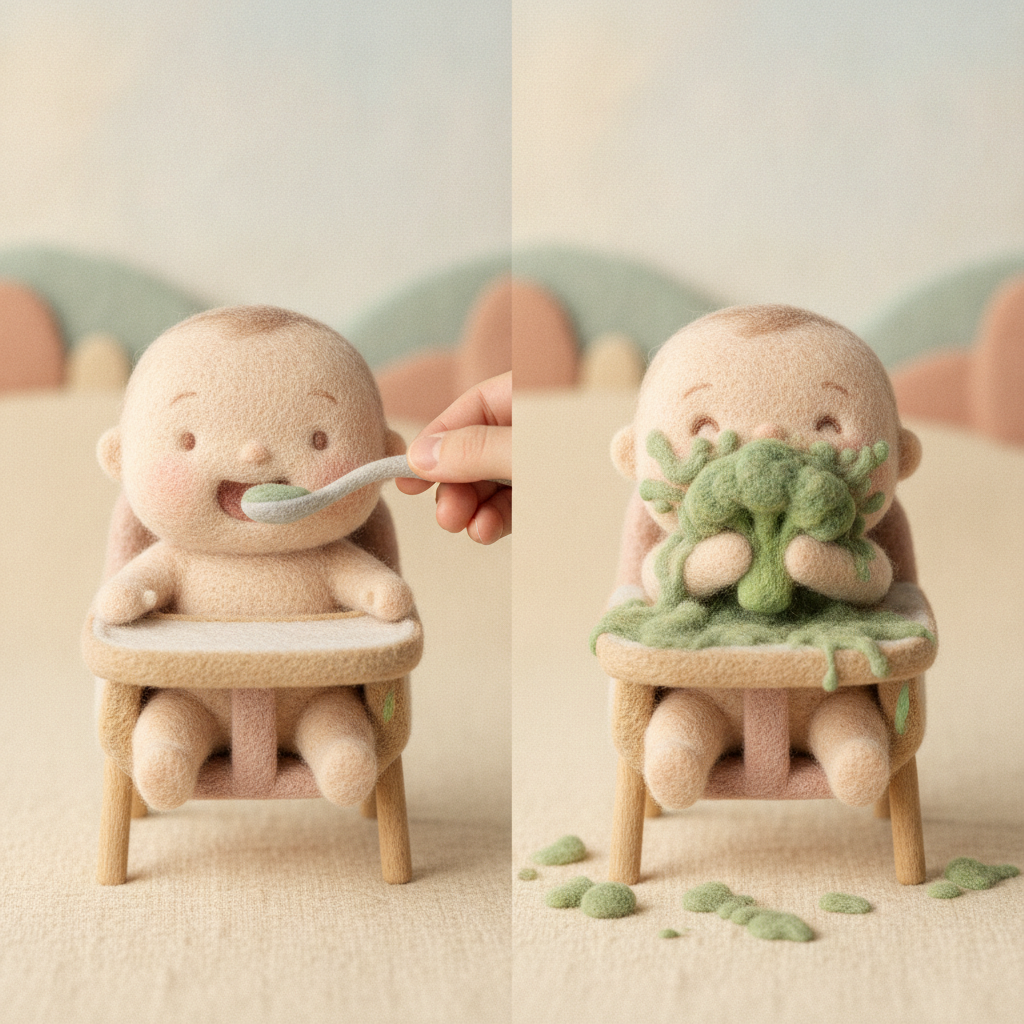
When it is time to introduce solid foods, you will likely stumble into one of the fiercest debates in modern parenting: Traditional Weaning (purees) versus Baby-Led Weaning (BLW).
Proponents of BLW claim that feeding a baby purees with a spoon delays their motor skills and makes them picky eaters. Proponents of traditional purees claim that handing a 6-month-old a piece of broccoli is a terrifying choking hazard.
Which method is clinically superior?
According to pediatric nutritionists and speech-language pathologists, neither method is inherently better. Both have benefits, both have drawbacks, and importantly, you do not have to choose just one.
Here is a clinical breakdown of both methods, the safety evidence, and how to combine them.
Traditional Weaning (Purees)
Traditional weaning involves feeding the baby smooth, pureed foods with a spoon, gradually introducing thicker textures and lumps over several months until they are eating table food.
The Benefits:
- Less Anxiety: For anxious parents, purees offer peace of mind. The risk of choking on a smooth puree is virtually zero.
- Nutritional Certainty: You know exactly how much the baby swallowed (unlike BLW, where most of the food ends up on the floor).
- Iron Intake: It is very easy to mix iron-fortified cereals into purees, ensuring the baby gets this critical nutrient (breast milk is naturally low in iron).
The Drawbacks:
- If parents get "stuck" on purees and fail to introduce lumps and finger foods by 9 months, the baby can develop texture aversions and oral-motor delays.
Baby-Led Weaning (BLW)
Baby-Led Weaning skips purees entirely. From day one (at 6 months of age), the baby is offered soft, appropriately sized pieces of whole food (like a thick wedge of avocado or a strip of slow-cooked meat). The baby feeds themselves; the parent never puts food into the baby's mouth.
The Benefits:
- Fine Motor Skills: BLW rapidly accelerates the development of the "pincer grasp" (using the thumb and index finger to pick up small objects) and hand-to-eye coordination.
- Appetite Regulation: Because the baby is in complete control of how much goes into their mouth, they learn to stop eating when they are full, which some studies suggest may prevent childhood obesity.
- Family Meals: The baby eats what the family eats (minus salt and sugar), saving the parent from having to cook separate meals or blend food.
The Drawbacks:
- The Gagging: BLW involves a lot of gagging. Gagging is a safe, natural reflex that pushes food away from the airway, but it is terrifying for parents to watch.
- The Mess: It is spectacularly messy.
The Choking Question: Is BLW Safe?
The biggest fear surrounding BLW is choking.
However, large-scale clinical studies (such as the BLISS study) have concluded that there is no increased risk of choking with Baby-Led Weaning compared to traditional spoon-feeding, provided that parents follow safety rules.
To safely practice BLW, foods must be:
- Soft enough to mash with your tongue against the roof of your mouth.
- Cut appropriately: In the beginning, foods should be cut into thick strips (about the size of two adult fingers) so the baby can grasp it in their fist and still have some sticking out to chew on. Round foods (grapes, cherry tomatoes) must always be quartered lengthwise.
The Clinical Middle Ground: Combination Feeding
You do not have to be a purist. Many speech-language pathologists (experts in swallowing mechanics) recommend a combination approach.
You can offer a pre-loaded spoon of oatmeal puree for the baby to hold and bring to their mouth (practicing motor skills with a puree), while also placing a large, soft spear of roasted sweet potato on their tray to explore.
The ultimate goal of the first year is exposure. Whether that exposure comes from a spoon or from a fistful of broccoli, as long as the food is safe and the baby is upright and supervised, they are learning exactly what they need to know.